


Blog
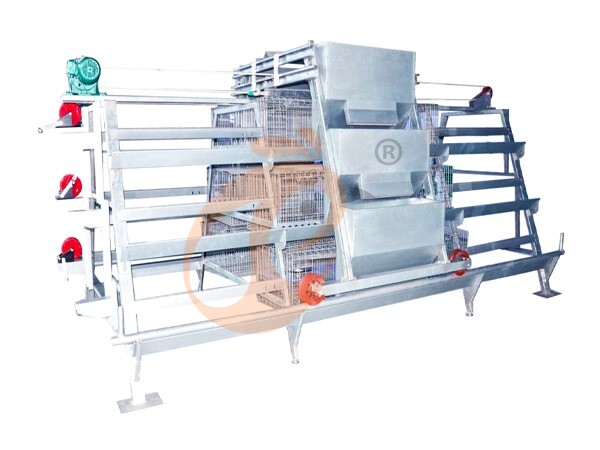
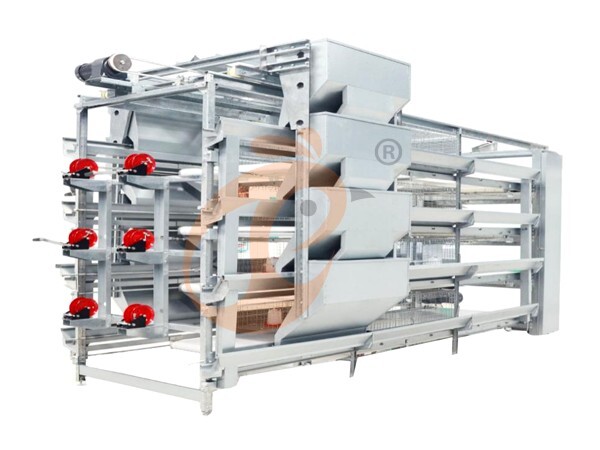
A type chicken battery cage economics combine factory pricing, 160 birds per set, automated workflows, galvanized steel, and measurable ownership value today.
Factory-direct sourcing coordinates cage frames, feeding, drinking, manure, and egg systems while maintaining 380 V/50 Hz electrical compatibility globally.
Capacity analysis connects 16,000-bird projects with layout efficiency, service access, spare-parts planning, and disciplined equipment specifications efficiently.
Automation converts repetitive work into controlled operations, with 3–4 tiers, programmable drives, and integrated technical documentation supporting stable production reliably.
- Commercial evaluation ultimately connects purchase price, service life, maintenance structure, and turnkey engineering into a practical investment decision for layer farms profitably.
Get professional poultry farm construction guidance, equipment selection solutions, and the latest price lists, whatsApp to +8618830120193, click to learn more:
Start With The Cost Structure, Not The Quotation
When poultry investors compare A type chicken battery cage systems, the lowest unit quotation does not necessarily create the lowest farm investment.
A factory direct chicken cage can control more cost layers because cage production, accessories, system integration, and technical support remain within one supply chain.
For example, a commercial layout can be engineered around a 50–60 m farm bay width and a 3.5–4.5 m usable house height, allowing an automatic layer cage system to match building conditions instead of requiring unnecessary structural modifications.
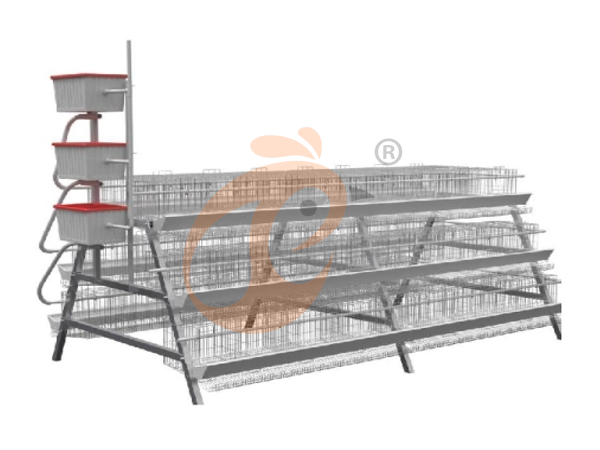
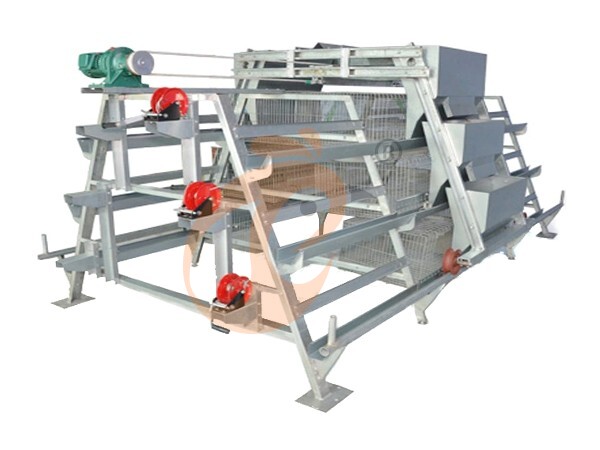
The A type configuration provides a practical balance between cage capacity and accessibility.
When the A type chicken battery cage integrates feeding, drinking, manure removal, and egg collection, buyers avoid separate engineering margins from multiple suppliers.
A properly planned installation can maintain a 1.0–1.2 m service aisle and use a 2.15 m longitudinal module, supporting routine inspection and maintenance.
Factory-Direct Pricing: Where The First Saving Appears
Data is for reference only.Swipe horizontally to view full table.
The first advantage of factory-direct purchasing is not simply a discount on steel.
Established A type chicken battery cage systems commonly use Q235 steel and hot-dip galvanizing, while manufacturers can coordinate the cage, feeding, drinking, manure, and egg-collection systems as one project.
The purchasing structure can also define 380 V/50 Hz power input and IP55 motor protection before production, reducing adaptation work after delivery.
More Birds Per Equipment Investment
The economic logic becomes clearer when the A type chicken battery cage is evaluated by birds served rather than cage price alone.
Data is for reference only.Swipe horizontally to view full table.
Published A type specifications show configurations ranging from approximately 96 to 160 birds per set, depending on cage dimensions and tier arrangement.
This matters because equipment investment follows the number of functional cage sets rather than simply the total chicken population.
An A type chicken battery cage can reduce the number of structural modules required for a target flock, while a 4-door configuration can support more organized bird access.
The same capacity logic can reduce installation interfaces, with 24-cell arrangements providing a defined planning basis for commercial layer projects.
One Factory Can Integrate The Entire Feeding Chain
A cage is only one part of a layer farm.
A factory direct chicken cage supplier can coordinate feeding, drinking, egg collection, manure handling, and control equipment as a connected production system.
Data is for reference only.Swipe horizontally to view full table.
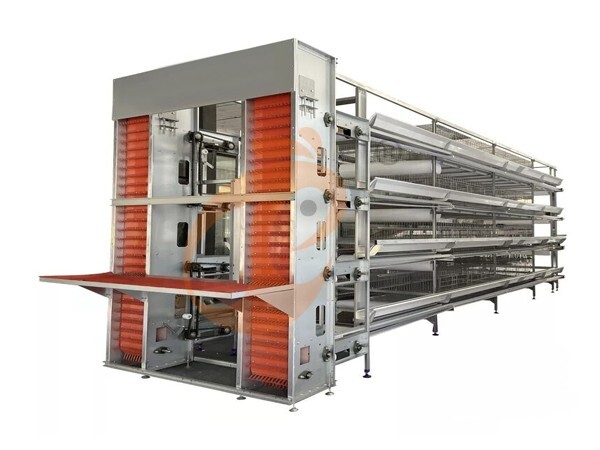
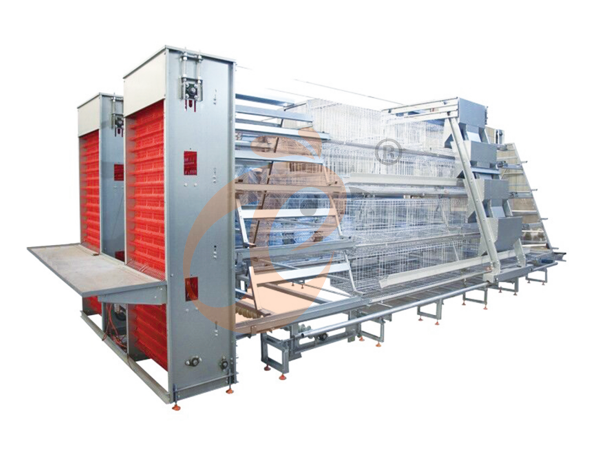
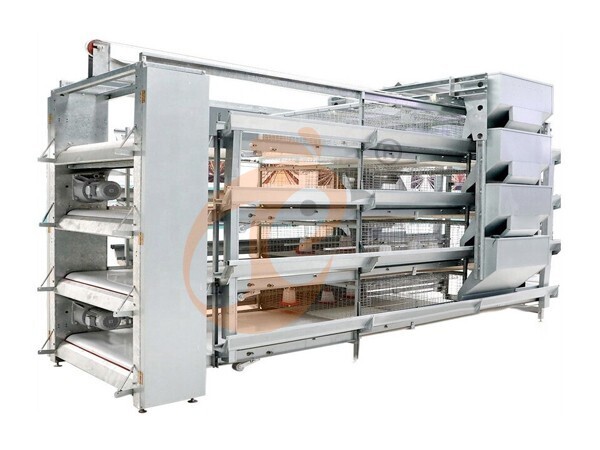
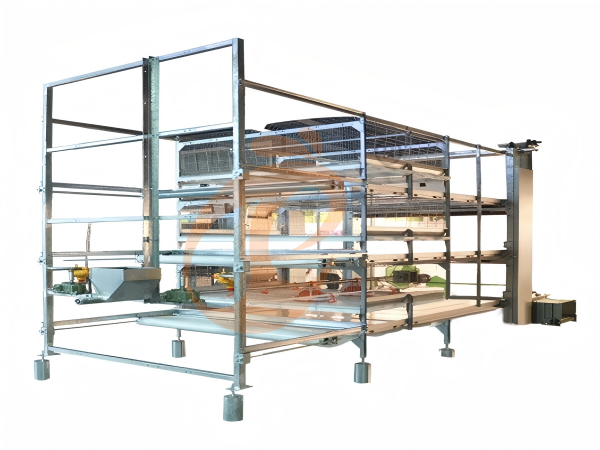
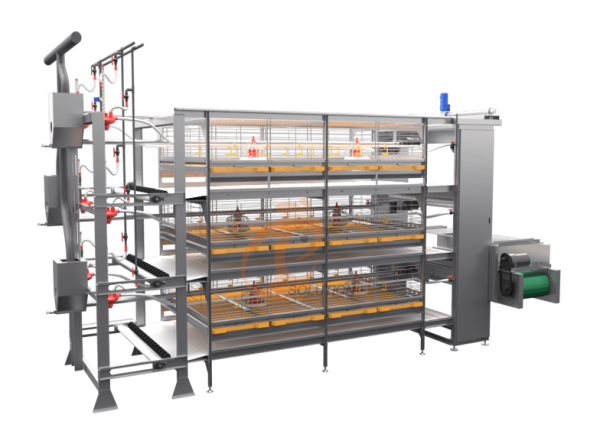
Automatic A type chicken battery cage systems can combine feeding, drinking, manure removal, and egg collection equipment into an integrated project.
The factory can design feed delivery around a 60–80 mm feed-drop opening while reserving suitable cable routes before shipment.
Such engineering coordination allows an automatic layer cage system to maintain consistent interfaces across mechanical and electrical components.
Galvanizing Converts Purchase Price Into Service-Life Value
Think Beyond Year One
A poultry cage operates around moisture, manure gases, cleaning chemicals, and continuous mechanical contact.
For an A type chicken battery cage, surface treatment therefore influences long-term equipment value and maintenance planning.
Factory production allows coating specifications to be defined before manufacturing rather than accepted as an unknown trading standard.
Data is for reference only.Swipe horizontally to view full table.
Published A type specifications distinguish electro-galvanized and hot-dip galvanized cage treatments with different coating characteristics and service-life references.
For investors, the coating decision should therefore be treated as a capital-protection decision.
A manufacturer can also match an A type chicken battery Cage to environmental conditions such as relative humidity above 70% and frequent wet cleaning.
A Factory-Direct Purchase Changes The Maintenance Equation
Picture Two Farms
Farm A purchases cages from one trader, feeding equipment from another supplier, motors locally, and water components from a third company.
Farm B purchases an A type chicken battery cage and associated systems directly from the manufacturer.
When a conveyor component requires replacement, Farm B has one equipment source, original drawings, compatible dimensions, and a unified spare-parts list.
Data is for reference only.Swipe horizontally to view full table.
The practical benefit is response consistency.
A manufacturer can document a 0.75 kW drive-motor circuit and a 24 V control-voltage circuit, making replacement and troubleshooting more predictable.
A unified automatic layer cage system also reduces uncertainty when mechanical and electrical components require coordinated servicing.
Automation Reduces The Cost Of Repetitive Farm Work
Four Reasons. One Operating Logic.
1 — Feeding: automatic distribution converts repeated manual carrying into scheduled equipment operation.
2 — Drinking: nipple systems provide controlled water delivery through a centralized line.
3 — Manure: conveyor removal transfers accumulated manure without repeated manual scraping.
4 — Eggs: conveyor collection moves eggs toward the collection point with less repetitive handling.
For an A type chicken battery cage project, automation transforms labor-intensive routines into machine-controlled processes.
Published automatic systems can reference 110–130 g feed per bird per day and 3–5 birds per nipple, providing practical planning inputs.
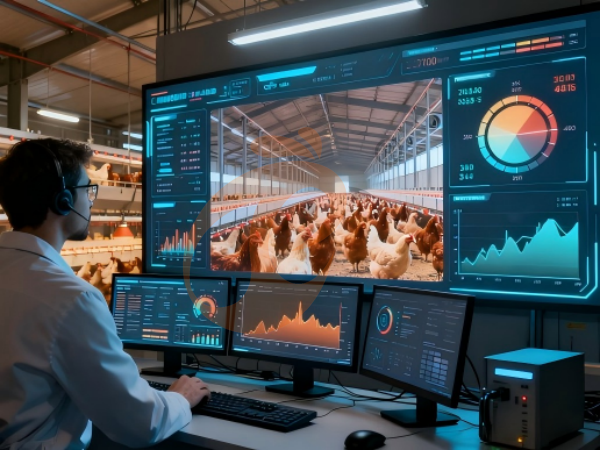
A properly integrated system can coordinate several operations through centralized control while the operator concentrates on flock observation.
Compare The Investment By Cost Per Bird
A professional purchasing decision should convert A type chicken battery cage expenditure into a comparable production metric.
Data is for reference only.Swipe horizontally to view full table.
The example demonstrates why factory-direct A type chicken battery cage purchasing should be evaluated against birds housed, service life, and system completeness rather than cage price alone.
European union standard reference only.
An investment model can also use a 15-year depreciation period and a 12-month operating cycle to compare direct procurement with distributor-led purchasing.
Factory Engineering Also Protects Floor-Space Economics
An A type chicken battery cage must fit the building, ventilation route, feeding equipment, egg-transfer route, and manure-discharge path simultaneously.
Data is for reference only.Swipe horizontally to view full table.
Published A type layouts demonstrate examples such as 86 × 8 m houses for 10,240 birds and 95 × 13 m houses for 20,160 birds.
A factory-direct manufacturer can produce the A type chicken battery cage layout around actual building dimensions instead of simply shipping standard cage sets.
Project engineering can account for a 3.0–3.5 m ventilation-service zone and fixed structural columns before equipment fabrication.
The Return On Investment Is Built From Four Separate Savings
Four Reasons. Four Financial Levers.
1 — Procurement: direct factory purchasing removes unnecessary distribution layers.
2 — Capacity: A type chicken battery cage multi-tier construction increases the number of birds served by each equipment module.
3 — Operation: automatic feeding, drinking, manure handling, and egg collection reduce repetitive manual work.
4 — Ownership: standardized galvanized components, compatible spare parts, and unified technical support simplify long-term maintenance.
These four advantages operate together rather than independently.
A buyer saving $0.50 per housed bird on initial equipment but spending more on labor and incompatible components may not achieve lower total ownership cost.
An automatic layer cage system should therefore be evaluated through measurable variables such as 18–24°C operating temperature and 0.2–0.4 MPa water pressure.
What Should Be Included In A Factory-Direct Quotation?
Before signing a purchase order, buyers should request a technical quotation defining exactly what an A type chicken battery cage package includes.
A reliable quotation should identify cage configuration, galvanizing process, feeding, drinking, manure removal, egg collection, electrical components, installation guidance, spare parts, packaging, and delivery terms.
Data is for reference only.Swipe horizontally to view full table.
The strongest factory-direct quotation functions as a technical contract.
It should also state container loading quantities and installation sequence, because logistics directly influence commissioning expenses for an A type chicken battery cage project.
Frequently Asked Questions
Q1: What makes a factory-direct A type chicken battery cage more cost-effective?
Factory-direct purchasing combines equipment manufacturing, system integration, and technical coordination within one supply chain.
A project designed around 16,000 birds can therefore be evaluated as one equipment package instead of several disconnected purchases.
Q2: Is A type chicken battery cage suitable for automated layer farms?
Yes.
An A type chicken battery cage can integrate automatic feeding, nipple drinking, manure removal, egg collection, and centralized controls.
A 0.75 kW-class drive motor can support selected conveyor applications, subject to final engineering calculations.
Q3: What should buyers compare besides the cage price?
Buyers should compare capacity, automation scope, material treatment, maintenance structure, spare-parts compatibility, installation requirements, and total ownership cost.
A professional comparison should use project-specific engineering data rather than relying on a single equipment quotation.
Taiyu (HK) Group - One Of China Largest A Type Chicken Battery Cage Manufacturer
A type chicken battery cage systems provide structured layer housing with 3–4 tiers, integrated equipment interfaces, and project-oriented capacity planning.
Global factory-direct supply covers poultry equipment packages, technical drawings, component matching, electrical coordination, and international project documentation.
Turn-key engineering connects cage installation, automatic feeding, drinking, manure removal, egg collection, and commissioning into one coordinated delivery structure.
Commercial projects can receive equipment planning, production coordination, container loading, installation guidance, and technical support through one factory-side communication channel.
Project execution follows equipment specifications, building dimensions, operating requirements, and system compatibility to establish a controlled layer-production infrastructure.
Contact Us To Received Your Customized Poultry Farm Plan
Headquarters And Branchs
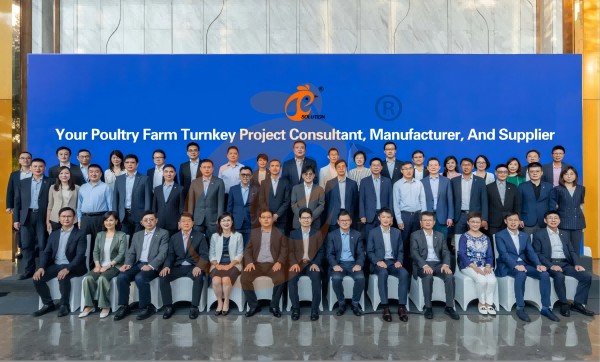
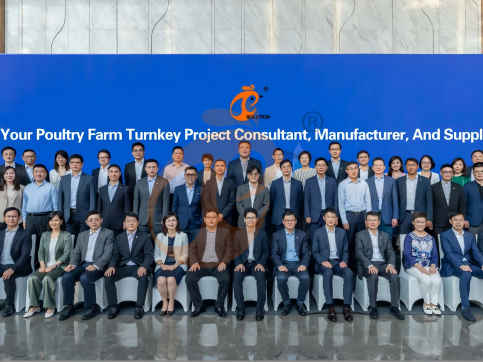
Hong Kong Headquarter Management Team
Hong Kong Headquarter Taiyu Industrial Group CO., LTD
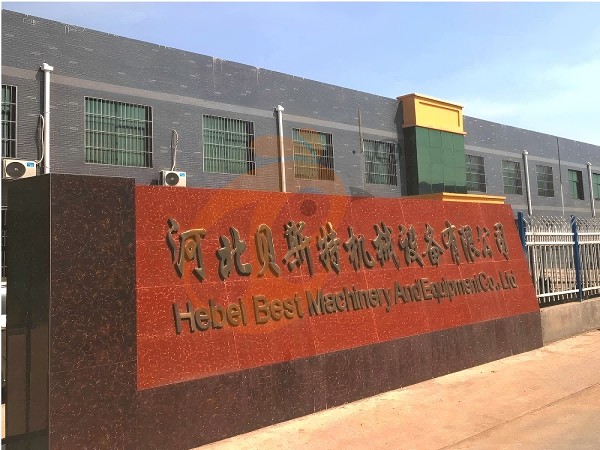
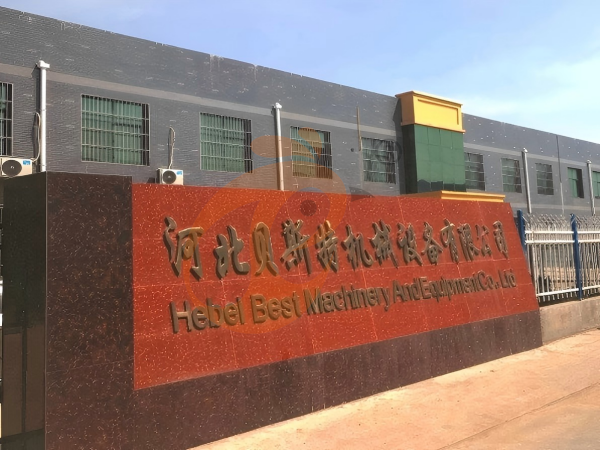
China Hebei Best Machinery And Equipment CO., LTD
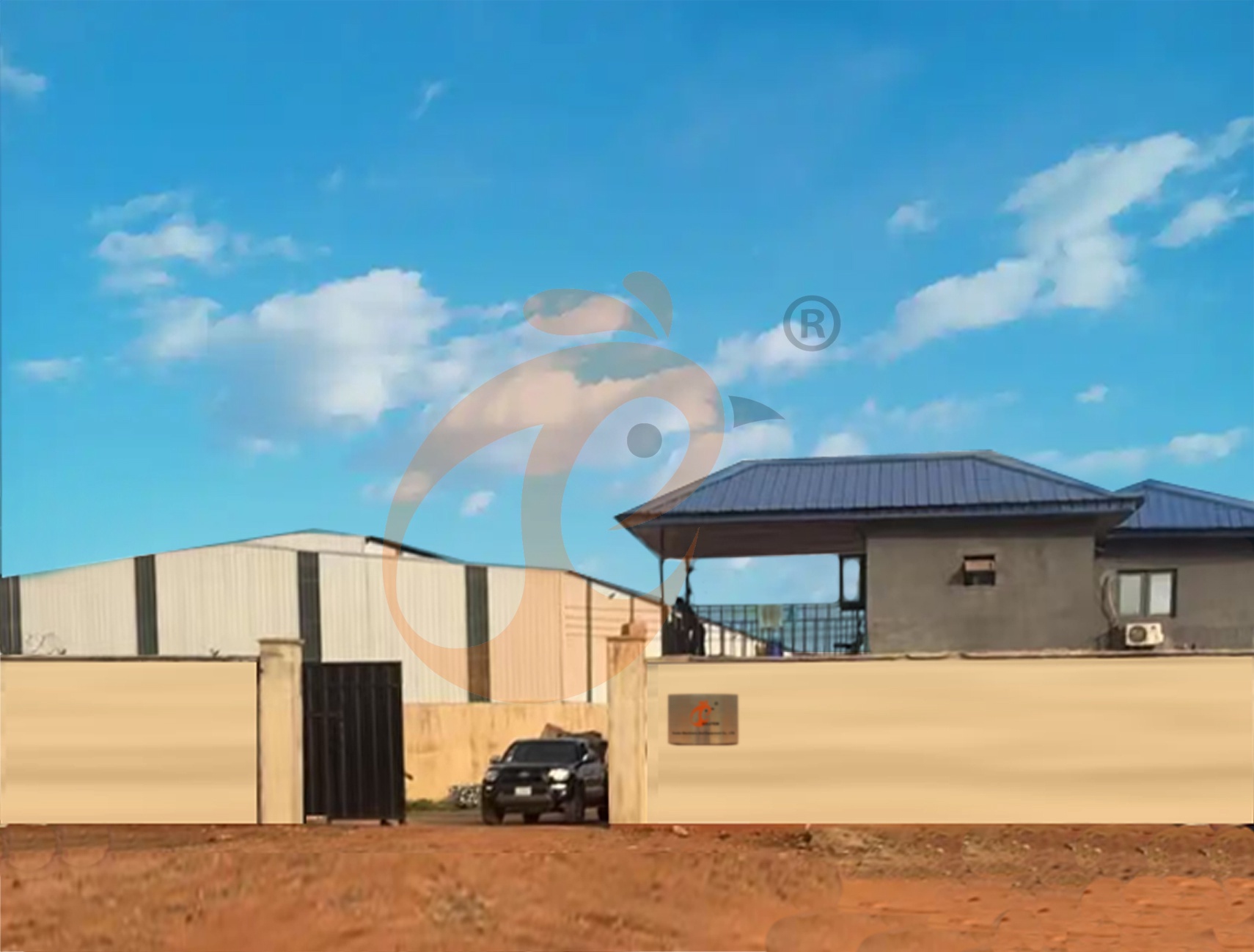
Nigeria Vanke Machinery And Equipment CO., LTD
Tanzania Best Machinery And Equipment CO., LTD
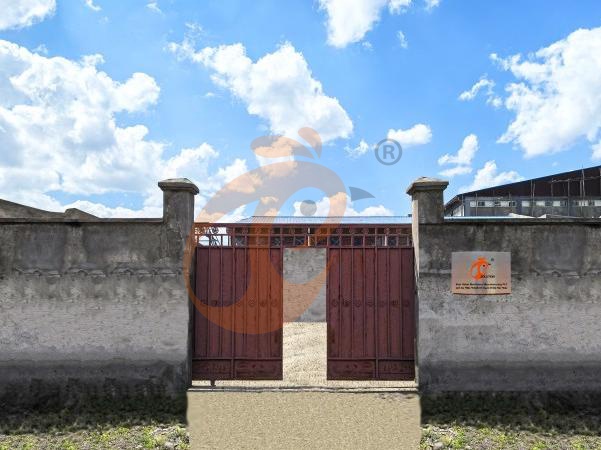
Ethiopia Best Hebei Machinery Manufacturing PLC
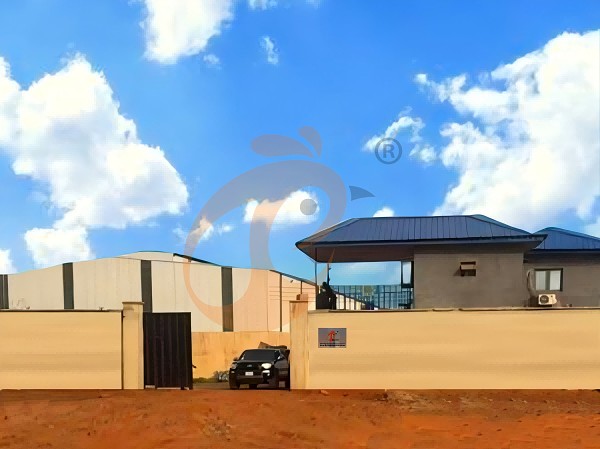
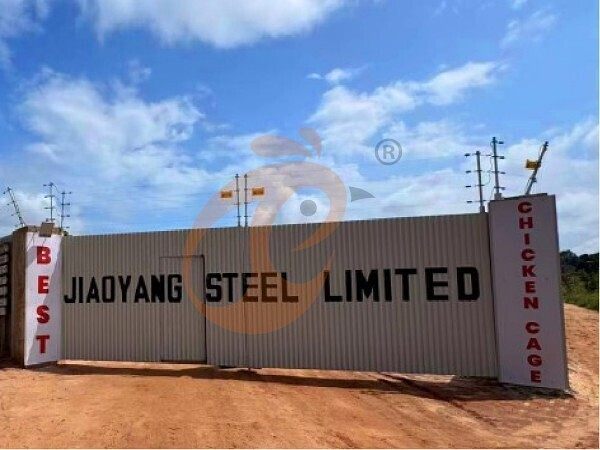
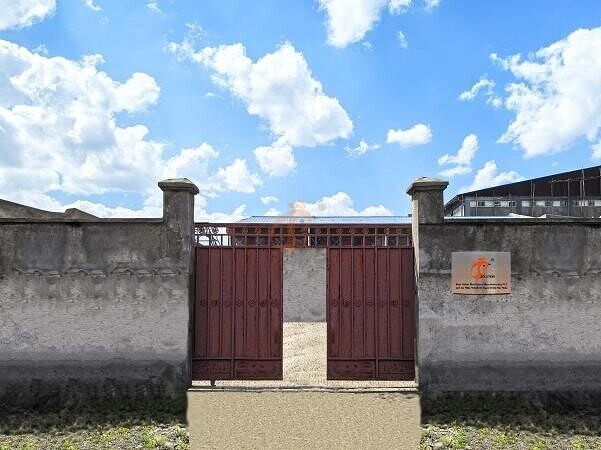
Reception /24 WhatsApp NO. : +8618830120193
FAQ
How To Optimize Lighting Program In A-Type Layer Cage Farm?
Even lighting promotes laying
Egg production rate: 90–96%
FCR: 1.9–2.2
Reduces stress
How To Implement Waste Management In A-Type Poultry Cage Farm?
Collect manure for organic fertilizer
Reduce pathogen spread
Mortality rate: 2–3%
Egg production rate: 90–96%
How To Improve Egg Weight In A-Type Layer Cage System?
Maintain stable temperature and humidity
Egg weight: 60–65 g
Egg production rate: 90–96%
Egg breakage rate <1%
- battery cage
- battery cage system
- poultry farm
- chicken cage
- chicken battery cage
- layer cage
- automatic layer cage
- poultry cage
- cage
- galvanized cage
- poultry farm construction
- battery cage manufacturer
- chicken battery cage manufacturer
- chicken battery cage system
- chicken battery cage layout
- layer cage system
- chicken cage supplier
- battery cage project
- battery cage layout
- poultry equipment
- egg collection equipment
- automatic layer cage system
- chickencage
- chicken battery
- bestchickencage
- cage system
- cage systems
- Nigeria
- automated layer farm
- layer farm
- cage manufacturer
- cage supplier
- poultry farm plan
- Ethiopia
Message
Products recommended
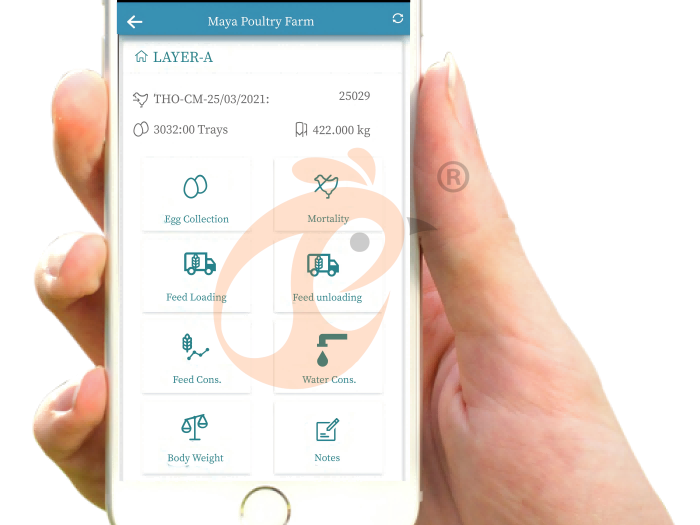
 >30,000 Pullets Automatic H Type Battery Cage1. More than 30,000 pullets a house, choose it.
2. It is designed to rearing older than 1 day old pullets to 12 to 16 weeks old chicken starting laying eggs.
3. Its lifespan is more than 25 years.
4. Its structure are Vcloud artificial intelligent fusion, electric control cabinet, automatic equipment of drinking, feeding, manure clean, manual harvesting.
5. Our 24 hour online reception What’sApp NO. is +8618830120193 <30,000 Pullets Automatic A Type Battery Cage1. 10,000 to 30,000 pullets a house, choose it.
2. It is designed to rearing older than 1 day old pullets to 12 to 16 weeks old chicken starting laying eggs.
3. Its lifespan is more than 25 years.
4. Its structure are Vcloud artificial intelligent fusion, electric control cabinet, automatic equipment of drinking, feeding, manure clean, manual harvesting.
5. Our 24 hour online reception What’sApp NO. is +86 18830120193. >30,000 Broilers Semi-Automatic Harvest H Type Battery Cage1. More than 30,000 broilers a house, choose it.
2. It is designed to rearing 1 to 45 day old adult broiler ready for market.
3. Its lifespan is more than 20 years.
4. Our 24 hour online reception What’sApp NO. is +8618830120193, +234 8111199996. >30,000 Broilers Manual Harvest H Type Battery Cage1. More than 30,000 broilers a house, choose it.
2. It is designed to rearing 1 to 45 day old adult broiler ready for market.
3. Its lifespan is more than 20 years.
4. Its structure are Vcloud artificial intelligent fusion, electric control cabinet, automatic equipment of drinking, feeding and manure clean, manual harvesting.
5. Our 24 hour online reception What’sApp NO. is +8618830120193, +234 8111199996. <30,000 Broilers Manual Harvest A Type Battery Cage1. Less 30,000 broilers a house, choose it.
2. It is designed to rearing 1 to 45 day old adult broiler ready for market.
3. Its lifespan is more than 20 years.
4. Its structure are Vcloud artificial intelligent fusion, electric control cabinet, automatic equipment of drinking, feeding and manure clean, manual harvesting.
5. Our 24 hour online reception What’sApp NO. is +8618830120193, +234 8111199996. HK Headquarter Offers EU-standard Poultry Farm Solutions, Manufacture Poultry Farm Equipment1. Continuous communication with the EU and the US
2. China, Nigeria, Ethiopia, Tanzania branch companies and factories
3. The products’ quality is customized for local poultry farms
4. Poultry cage and poultry farm equipment stock for sale
5. 24 online reception Whatsapp NO. : +8618830120193,contact us to get full information China Branch Offer Poultry Farm Business Plan, Manufacture Poultry Farm Equipment1. Address: Flat/RM 2416, 24/F, Runxing Building, Youyi Nan Street, Shijiazhuang City, Hebei Province, China
2. Poultry cage and poultry farm equipment factory and stock for sale
3. Customized for local poultry farms
4. Quality and design are based on Euro
5. 24 online reception Whatsapp NO. : +8618830120193 Nigeria Branch Offer Poultry Farm Business Plan, Manufacture Poultry Farm Equipment1. Address: After Sinoma Office, 200 Meters Near Danco Filling Station, Lagos/Ibadan Expressway, Lagos State, Nigeria
2. Poultry cage and poultry farm equipment factory and stock for sale
3. Customized for Nigerian poultry farms
4. Quality and design are based on Euro
5. 24 online reception Whatsapp NO. : +8618830120193 Ethiopia Branch Offer Poultry Farm Business Plan, Manufacture Poultry Farm Equipment1. Address: Gelan Gura, Akaki-kaliti Sub City, Addis Ababa, Ethiopia
2. Poultry cage and poultry farm equipment stock for sale
3. Customized for Ethiopian poultry farms
4. Quality and design are based on Euro
5. 24 online reception Whatsapp NO. : +8618830120193, contact us to get price list Tanzania Branch Offer Poultry Farm Business Plan, Manufacture Poultry Farm Equipment1. Address: No.8, Sova Road, Msufini, Mlandizi, Kibaha, Pwani, Tanzania
2. Poultry cage and poultry farm equipment factory and stock for sale
3. Customized for Tanzanian poultry farms
4. Quality and design are based on Euro
5. 24 online reception Whatsapp NO. : +8618830120193

Contact